

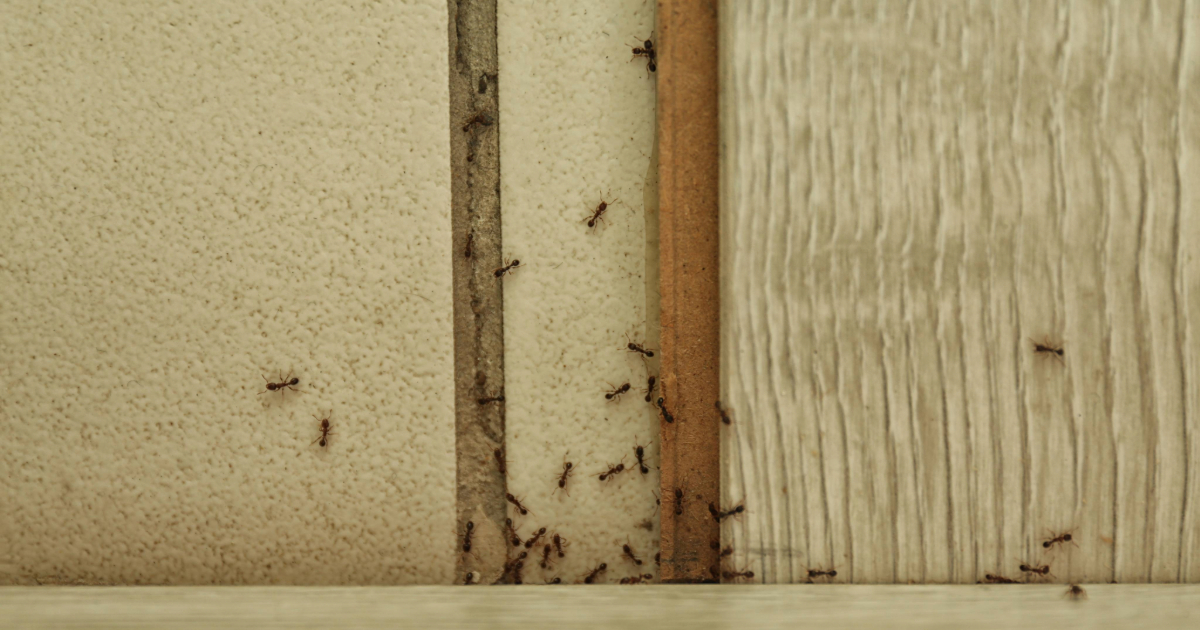
If you’ve got ants in your house, you already know how frustrating it is. You wipe the bench down, you put the food away, you think you’ve sorted it, and then the next morning there’s a fresh trail of the little things marching across your kitchen floor like they own the place.
The good news is that most ant problems can be dealt with at home. The bad news is that a lot of the quick fixes people reach for first, like surface sprays, don’t actually solve the problem. They kill the ants you can see, but the colony keeps going. To actually get rid of ants, you need to understand why they’re there and target the source.
Quick answer: The most effective ways to get rid of ants at home are ant bait (which workers carry back to kill the queen), sealing entry points, and removing food sources. Surface sprays work short-term but rarely solve an infestation. If ants keep coming back despite your efforts, you likely have a colony nesting in or under your home, and that’s when it’s worth calling pest control.
Why Are Ants So Hard to Get Rid Of?
The reason ants are so persistent is that you’re almost never dealing with a few individual ants. You’re dealing with a colony, and colonies can have tens of thousands of ants. If you kill every ant you can see but leave the queen alive underground somewhere, she’ll just keep producing more workers. The visible ants you’re swatting at are maybe five per cent of the actual population.
Some ant species, like the Argentine ant and the Big-headed ant, make things even more complicated by having multiple queens within the same colony. More queens means more eggs, more workers, and a much harder time eliminating the whole nest. Argentine ants are particularly notorious for this, and unfortunately they’re widespread in Australian cities.
Surface sprays confuse things further because many of them have repellent properties. The ants sense the chemical and reroute rather than walk through it. So you spray your kitchen, the ants disappear from that spot, and you think it’s worked. Then a week later they’re back, or they’ve found a different entry point.
How to Get Rid of Ants: What Actually Works
Use Ant Bait, Not Just Spray
Ant bait is the most reliable DIY method for dealing with a proper infestation. The idea is that worker ants find the bait, eat it, and then carry it back to share with the rest of the colony, including the queen. It’s slow (it can take a few days to a couple of weeks), but it targets the source rather than just the workers you can see.
You can buy ant bait stations at any hardware store or Bunnings. The active ingredient in most of them is borax or a similar slow-acting substance. Place them near ant trails, but resist the urge to spray the area at the same time. If you spray, you’ll kill the workers before they have a chance to take the bait back to the nest, and the whole point of bait is that it travels.
The key with bait is patience. You’ll probably see more ants initially as they swarm the bait, which feels counterintuitive. That’s actually what you want. More ants taking bait back to the colony means the solution is working.
One thing to keep in mind if you have kids: bait stations look interesting to small children, and some of them are sweet-tasting by design (that’s the point). Place them out of reach, behind appliances or up under the lip of the kickboards under your kitchen cabinets, somewhere ants can still access them but little hands can’t.
Block Up Entry Points
Ants don’t appear from nowhere. They’re getting into your house through specific gaps, and finding those gaps is half the battle.
Follow the ant trail backwards, away from wherever they’re congregating, and trace it back to where they’re coming in. Common entry points include gaps around pipes where they enter the wall, cracks in weatherstripping around doors and windows, gaps in floorboards, and spaces where cables or conduits run through external walls.
Once you’ve found the entry points, seal them. Silicone sealant works well for most gaps. For larger gaps around pipes, use a foam filler followed by sealant. It’s not glamorous work, but it’s one of the few genuinely permanent fixes.
Remove the Food Sources That Are Attracting Them
Ants are in your house because there’s something worth coming in for. Food and moisture are the two big attractants.
I’ll be honest: this is the hard part when you’ve got kids. My two boys are at an age where every surface within a metre of wherever they’ve been sitting is covered in crumbs. Toast crusts, biscuit fragments, a mysterious sticky patch of unknown origin. It’s basically an open invitation for every ant within a fifty-metre radius. I’ve accepted that I’m not going to win the war on crumbs entirely, so I focus on the things I can actually control.
Make sure bench tops are wiped down after cooking and after kids eat, especially if they’ve been into the biscuit tin or having fruit. Store sugar, honey, jam, and anything with high sugar content in sealed containers. Pet food bowls are a classic ant magnet too. And get into the habit of sweeping or vacuuming under the kitchen table after meals rather than leaving it until the end of the day, because that’s where the crumbs end up and that’s where the ants will find them.
Moisture is often overlooked. A dripping tap under the sink, a slow drain, or condensation around pipes can attract ants looking for water, regardless of how clean your kitchen is. Fixing these things removes an attractant that has nothing to do with food.
Try Natural Deterrents for Minor Problems
If you’ve got a small number of ants and you’re not sure yet whether it’s a full infestation, natural deterrents are worth trying before you go straight to chemicals.
White vinegar mixed with water in a spray bottle disrupts the pheromone trails that ants use to navigate. When ants find a food source, they leave a scent trail for other ants to follow. Spraying vinegar over these trails scrambles the signal. Use roughly equal parts vinegar and water, or go stronger if you prefer. It does smell a bit, but it clears quickly.
Peppermint oil, cinnamon, and ground pepper have similar pheromone-disrupting effects. These work better as preventative measures along windowsills and doorframes than as a cure for an active infestation. If you’ve already got hundreds of ants marching across your kitchen, sprinkling cinnamon at them isn’t going to cut it.
Diatomaceous earth is worth knowing about too. It’s a fine powder that’s non-toxic to humans and pets but dehydrates insects that walk through it. You can sprinkle it around entry points and along ant trails. It works well outdoors around the base of exterior walls. The only caution is to avoid letting kids (or pets) inhale it in large amounts, though food-grade diatomaceous earth is generally considered safe.
Pour Boiling Water on Outdoor Nests
If you’ve found ant nests in your garden or lawn, boiling water is one of the simplest ways to deal with them. Pour it directly into the mound. It kills large numbers of ants quickly, and unlike chemical treatments, it doesn’t contaminate the surrounding soil.
You’ll often need to repeat this a few times over several days to reach the deeper parts of the nest. It’s not a guaranteed fix, but for a backyard nest that isn’t too established, it’s a decent starting point.
Why Do I Have Ants in the First Place?
Ants are everywhere in Australia. There are around 1,300 native species, and a number of introduced ones, so the idea of a completely ant-free yard is not really realistic. What you can do is make your house less worth entering.
The most common reason ants come indoors is food. Sugar, syrup, fruit, meat, and fats all attract them. Once scouts find a food source, they lay down pheromone trails back to the colony, and soon you’ve got a highway of workers following the same route. In summer this tends to get worse because ants are more active in warmer months. In Melbourne particularly, ant activity peaks between October and March, though in cooler weather they sometimes move indoors in search of warmth.
Moisture is the other big one. A leaky pipe or a poorly draining sink can attract ants even if your kitchen is spotless.
Do I Have Ants or Termites?
It’s worth knowing the difference, because the consequences of getting it wrong are significant. Termites can cause serious structural damage to your home; ants generally can’t, unless they’re nesting in timber that’s already rotting.
The easiest way to tell them apart is by their body shape. Ants have a narrow, pinched waist, which gives them that classic segmented silhouette. Termites are more uniform in shape, almost like a thick straight tube. Ant antennae are bent at an angle, while termite antennae are straight. If you’re seeing white or cream-coloured insects, those are almost certainly termites, not ants, and that’s a call-the-professionals situation rather than a DIY job.
Common Ants You’ll Find in Australian Homes
Not all ants behave the same way, and knowing what you’re dealing with helps you choose the right approach. Some of the most common species found in Aussie homes include the white-footed black house ant, the coastal brown ant, the Argentine ant, the Big-headed ant, the sugar ant, and the Pharaoh ant.
The Argentine ant is probably the most frustrating because of those multiple queens mentioned earlier. They form supercolonies, don’t fight with each other the way other ant species do, and spread rapidly. If you’ve got a recurring infestation that doesn’t respond to bait or other treatments, Argentine ants are a likely culprit, and professional treatment is usually the most practical solution.
When Should You Call a Pest Controller?
Look, most small ant problems can be handled at home with bait and some basic prevention. But there are situations where DIY methods aren’t going to be enough.
If you’ve tried bait, sealed entry points, and cleaned up food sources and the ants keep coming back, you almost certainly have a colony nesting in or directly under your home. Wall cavities, subfloor spaces, and roof voids are all common nesting spots for certain species. You can’t bait your way out of a nest that’s already established inside your walls.
Similarly, if you can’t figure out where they’re coming from despite following the trails, a pest controller can identify the species, locate the nest, and use treatments that aren’t available over the counter. Professional ant treatments often involve a combination of targeted baiting and residual insecticides applied around the perimeter of the home, which provides much longer-lasting protection than anything you can buy at Bunnings.
If you’ve got a large lawn nest, multiple nests across your property, or nests under pavers or concrete slabs, professional treatment is also worth the investment. These situations are very hard to resolve completely without the right products and equipment.
