

Choosing a kitchen sink is an important decision you’ll be making when building or remodeling a kitchen, but with so many options, it’s a decision that can become quite draining. Here’s a concise summary of the variables relevant to my decision making as concise as I can make it, as well as my take 5 years into using my new sinks.
We ended up going with the dual tier Ruvati Roma 33“, and single tier 15″ model for the second sink/coffee station, and as happy as I am with the both sinks, regarding the first one, I regret paying extra for the higher end model with the second tier I never use, and I regret buying the variation that included all the accessories.
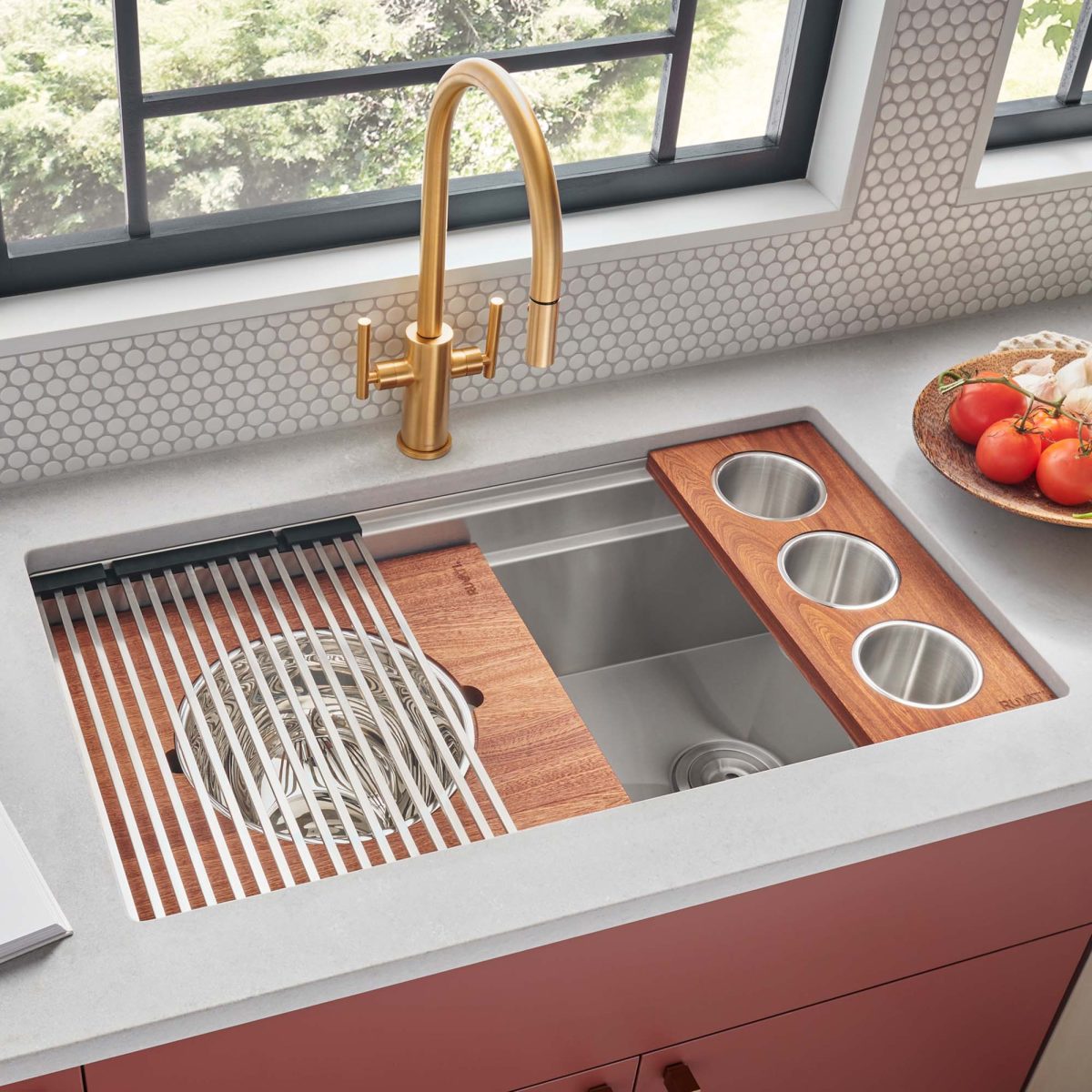
- Depth: The standard depth is around 8 to 10 inches / 20 to 25cm. Anything shallower will make it difficult for you to have enough space to wash dishes. A deeper sink is helpful for anyone cooking for a big family or entertaining guests, or when cleaning oversize pots.
Are you tall or short?
A shallower bowl depth allows a shorter person (less than 5’4” / 162cm) to work in the sink without having to lean into it to wash items in the bottom. Taller folks (taller than 6’2” / 187cm) can work in a shallower sink without having to crouch down or hunch over.
If space and budget allow, and you like this style, consider installing a double-bowl with different bowl depths. A larger, deeper sink can be used for hand-washing oversize items, and a more shallow sink provides an ergonomic option for those who find a deep sink uncomfortable to use for long periods.
Minor complications:
A sink grid as shown below makes a sink easier to use and keep clean, but will lose you roughly ½” / 1.5cm in depth.

However, if you get an undermount sink (see below), you’ll gain the thickness of your countertop in depth. - Single or double-bowl?
If you’re on the fence about this, I recommend this article:
Single-Bowl vs. Double-Bowl Sinks: Which Is Better? | Hunker
After years of double-bowl sinks, I am a thorough convert of one massive sink over a double-bowl sink. - Thicker steel for sound absorption, dent resistance, and pop resistance when pouring hot water. (16-gauge is the thickest on the market, though 18-gauge is not much thinner). We noticed right away the difference between our old sink and new one. Night and day.
- Stainless steel alloy. 201, 301, 304 or 316? 304 is best for almost all domestic kitchens.
If budget allows, choose a better steel alloy that doesn’t tarnish or stain as easily. In summary, Type 301 or 201 are average, while type 304 is best for most kitchens.
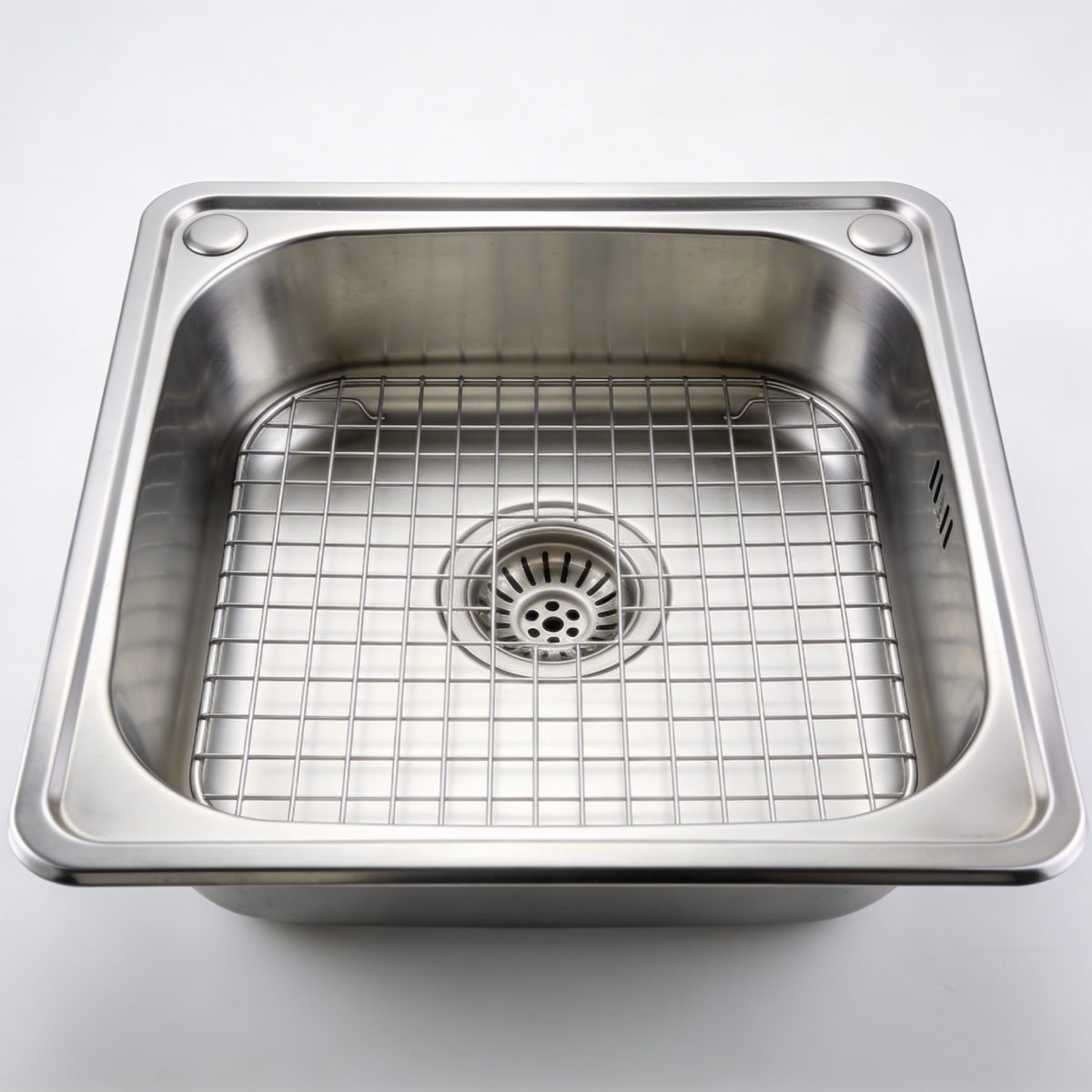
If you need something tougher and more resistant to extreme conditions, Grade 316 is more expensive but might be the better choice. Similar to 304 alloy, it includes molybdenum, which makes it extra resistant to rust and corrosion, especially in salty or acidic environments. 316 becomes necessary for places that are exposed to things like saltwater or harsh chemicals, like coastal homes, commercial kitchens, or even medical facilities. 316L is the low carbon variant, which adds further longevity, especially if welded, which is not relevant to most sink designs.
- Undermount or drop in?
Undermount sinks have no lip to overcome when wiping from the countertop into the sink. We love this feature and will never go back.
More pros and cons are listed in this article Types of Kitchen Sink Mounts | Insane Choices - Accessory tiers – one is perfect.
I regret paying for two-tier. We love having a tiered ledge built into the sink on which to prop a cheap Ikea colander or the cutting board that came with the sink.
I spent extra to get a dual tier sink, so that I can slide the cutting board over a colander or other accessories, but in reality, we never use the second tier, or the other accessories at all.
Note that my Ikea strainer fits perfectly across my top tier on my 33” wide sink, but not my longer 15” wide sink. - Side drain, rather than center.
Depending on your cabinet situation, this allows for better use of under-sink space once the garbage disposal and P-trap pipe is attached. - Sound absorption pads
Placed on the sides and under sink, these actually dampen the sound of using your sink. And though you can buy aftermarket addons and glue them on yourself, you may as well get a good enough quality sink that already includes this.
Official Accessories:
During my research, I was mesmerized by all the fancy accessories you can bundle with your sink. After 5 years I can say with confidence which are essential in my opinion, and which I feel like I wasted money on.
-
Sink grid – these are popular for good reason
They protect your sink from dents, dampen sounds, and make it easy for bits of food to flow down the drain underneath all your items stacked in the sink. A must-have.
-
Cutting board – functions exceedingly well, with caveats.
The included cutting board is not ideal. African Mahogany is not a good wood to use for a cutting board. Both boards chipped on the edges quickly, knife marks show up very quickly and look ugly, and oiling it is more difficult than my other boards. It looks ugly as all hell. However, it has good weight to it, and fits in the accessory spots perfectly, so we use it very frequently. It has held up remarkably well, but I its hardness bluntens my knives. Once it wears out for whatever reason (though 5 years of heavy use in, this seems unlikely), I plan to replace it with a better wood like teak (which America’s Test Kitchen recommends (YouTube link), even though that too is also quite hard and will blunten knives). I’ll take my few board to a woodworker friend to cut it to size.
-
Included colander – too heavy to use
The included rectangular colander fits in the sink’s tier, but is made of thick stainless steel, making it very heavy to move around, and takes up a lot of space. It is also to clean the corners and holes, though this wouldn’t be an issue in the dishwasher, if you’re fine with it taking up almost half of your bottom dishwasher rack (which I am not).
Below I suggest getting two of the smaller, light Ikea collanders. (See “Aftermarket Accessories”) -
Drying rack – too difficult to clean.
This gets moldy quickly. Cleaning the wire rack is much easier with a large brush (see the Winco Cutting Board Brush below). We have enough countertop space, that we can set out our clean dishes next to the sink, either on dish towels or drying mats instead (see below).
-
Wire rack feet and bumpers replacements for when they wear out
I had no idea these were something I would be looking to replace after just 2 years of use. Both the wire rack feet and bumpers got a very difficult to thoroughly clean black sludge in them, and constant slamming against the sink walls eventually loosened the bumpers. Eventually a couple bumpers came off and went down the drain.
Amazon sells replacements for my Ruvati model for $12 here. -
Wood platform mixing bowl and colander with slicer and grater attachments
While a good quality deep mixing bowl and deep colander are good to have, I never pull out the wooden platform to suspend the bowl in my sink. Perhaps this is useful for small kitchens.
Furthermore, the grater and slicer accessories are the worst I have ever used. Made of thick, blunt metal, you’d be much better off buying an adjustable mandoline (we love our Super Benriner no. 95), a mandoline grater or a traditional box grater.
Aftermarket Accessories:
-
Winco Cutting Board Brush
A cutting board brush, such as this one from Winco, make cleaning the sink, any sink, and the wire rack much quicker and easier. $7 on Amazon, or also available at restaurant supply stores.
-
Dish drying mats
Above I mentioned that the included drying rack that rolls out above our our sink is too difficult to clean and takes up sink space. We tried many dish drying racks of various design types and price points. In the end, we found two smaller size (16”x18”) dish drying mats (not a single large one) were the perfect solution. They’re small enough to move around and stack, and don’t draw the eye’s attention to themselves when sitting there empty, and they’re easy to clean by throwing in the laundry machine.
Norpro 16”x18” microfiber dish drying mats are $8 on Amazon. -
A light colander that suspends over your sink
I joke that “friends don’t let friends buy Ikea”, but I have plenty of exceptions. Ikea’s stainless steel collanders fit perfectly across my main sink’s tier lip, are extremely light, and are machine washable. I bought two and they’re so often in simultaneous use I bought a third. After 3 years of very heavy use the handle broke off one, but at $10, I still recommend it.
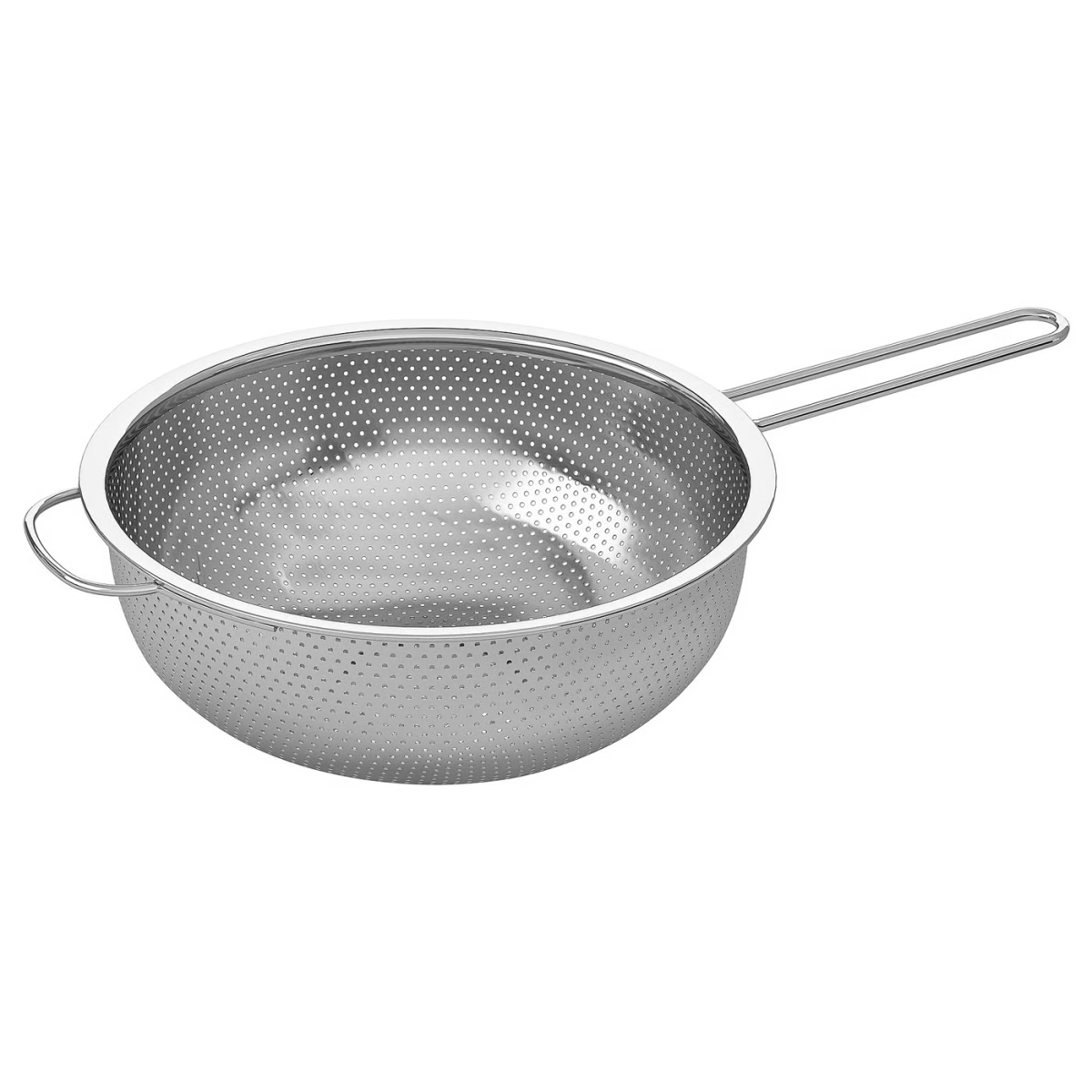
At 16” end to end, the Ikea Idealisk 10” collander fits perfectly on the tier lip across my sink
I don’t recommend across-sink colanders with extendible arms. I found that the moving parts break.
In conclusion
Pay extra for thicker steel, pay extra for the 304 alloy, and a tier lip, consider the included cutting board if they sell this accessory, but get your own accessories thereafter.
Have any questions or your own experiences to add? I’d love to hear them.
Further reading:
Other articles on my kitchen renovation:
Installing a deeper countertop – issues and lessons