

If you’re building a new home in Australia, you will almost certainly encounter four terms before a single wall goes up: site cut, soil test, survey and slab. They get mentioned in contracts, thrown around by builders at initial meetings, and listed on progress payment schedules with a matter-of-factness that assumes you already know what they mean. Most people don’t, and no one is in a hurry to explain them.
That is not a conspiracy. It is just the way the building industry communicates with itself rather than with its customers. So here is a plain-language rundown of what each stage actually involves, why it matters, and what it means for your build.
Site cut
The site cut is exactly what it sounds like. Before construction can begin, the land needs to be prepared, and that means cutting into, levelling, and reshaping the ground to match the engineered plans for your home. On a flat block, this might be minimal. On a sloping or uneven block, it can be a significant earthworks operation involving excavators and a lot of removed material.
The site cut determines where your floor level will sit in relation to the natural ground. It also affects drainage, which is not something to treat lightly. Poorly considered earthworks can push water toward your home or your neighbour’s property, and fixing that after the fact is expensive and unpleasant. Retaining walls, cut and fill calculations, and the relationship between your finished floor level and the street crossover all get sorted out at this stage.
If your block is listed as having a significant fall, expect your builder to reference the site cut when explaining why your build costs more than the advertised base price. The cut is where a lot of that additional cost lives.
Soil test
A soil test, sometimes called a geotechnical investigation, determines what is actually under your block. That matters because Australian soil conditions vary enormously, and the type of soil directly influences what kind of footing or slab system your home needs.
The results of a soil test are expressed using a classification system. Class A refers to stable, essentially non-reactive soil. From there, classifications move through S, M, H1, H2, E and P, with each step indicating increasing reactivity or instability. Reactive soils expand when wet and contract when dry, which puts movement pressure on whatever is built on top of them. Class P soil has particular problems, whether that is soft fill, landslip risk, or other conditions that require engineering attention.
Builders need a soil test before they can finalise your slab design. If your contract says the base price assumes a Class M soil and your test comes back H2, you will be paying more. This is one of the things worth asking your builder about before you sign, because soil surprises are a dependable source of variation cost on new builds.
Survey
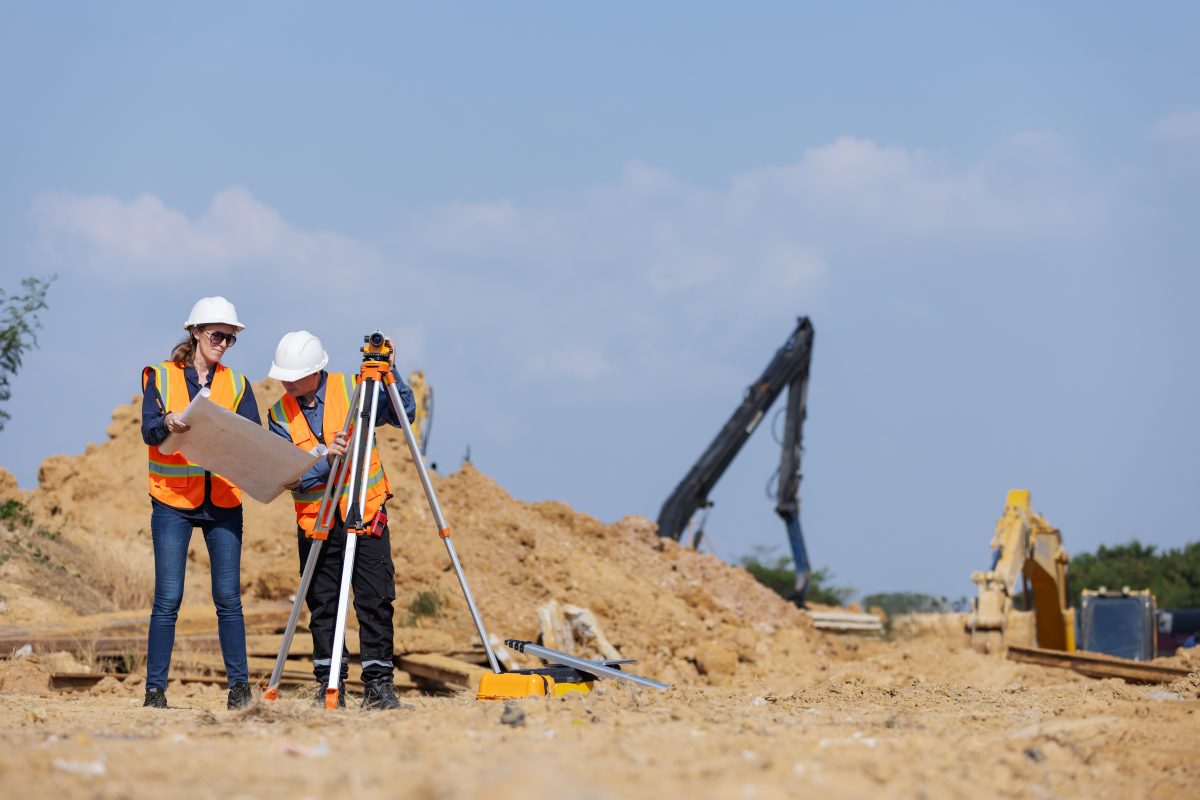
The survey stage involves a licensed surveyor physically marking the boundaries of your block and establishing the exact position where your home will be placed on it. This is called a site survey or feature and level survey, depending on what it covers.
It sounds administrative, but it is foundational in the most literal sense. Without a survey, your builder cannot confirm that the footprint of your house sits within your property boundary, maintains required setbacks from fences and neighbouring structures, and aligns with local council requirements. Encroachment onto a neighbouring property or a council easement is not a problem you want to discover after the concrete has been poured.
In most states, a surveyor will also peg out the corners of your home on the block prior to the slab being laid, a process known as a set-out survey. This is separate from the initial feature survey and is another point in the process where a licensed professional confirms everything is where it is supposed to be.
Slab
The slab is your concrete floor, and it is the first thing that looks like a house. After the site cut, soil test and survey have been completed and the engineer has specified the appropriate footing system, the slab is formed and poured.
In Australian residential construction, the most common slab types are waffle pod slabs and conventional raft slabs. A waffle pod slab uses polystyrene pods to create a grid-like void beneath the concrete, reducing the volume of concrete required while maintaining structural performance. A conventional raft slab is a solid poured slab with deeper edge beams. Which one your builder uses will depend on the soil classification, the site conditions, and their standard construction method.
The slab also contains your plumbing rough-in, meaning the pipes for your wet areas are laid in the ground before the concrete is poured. This is worth knowing because changes to bathroom and kitchen layouts become significantly more difficult and expensive once the slab is down. If you are still finalising your floor plan, do it before the plumber goes in.
Why these four stages matter together
Site cut, soil test, survey and slab are sequential for a reason. Each one informs the next. The soil test shapes the slab design. The survey confirms placement before the slab is poured. The site cut establishes the conditions that the slab will be built on. Skipping or rushing any of them introduces risk that tends to show up later, in the form of cracking, movement, drainage problems or disputes about setbacks.
For anyone building for the first time, understanding these stages will not make you an expert, but it will help you ask better questions, read your contract more carefully, and know what your builder is actually talking about when progress payments come due.

