

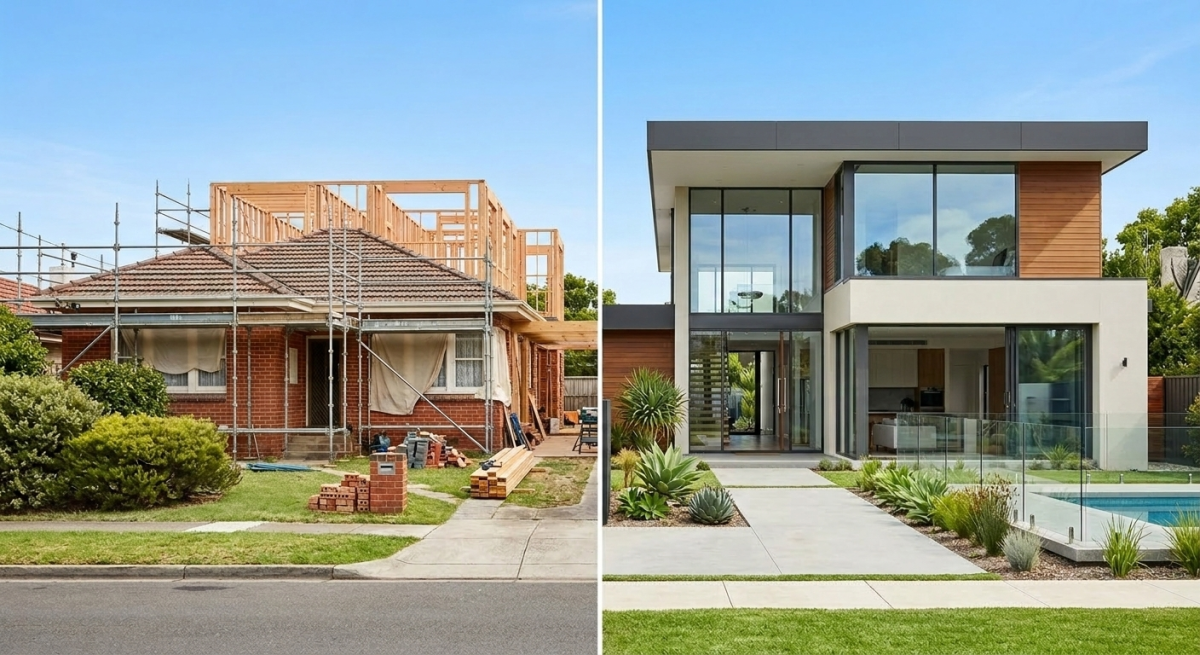
The question sounds simple enough. You have a house that isn’t working for you, and you need to decide whether to gut it and start again or pull it apart and put it back together differently. Both options will cost more than you expect. Both will take longer than the builder tells you. The real question isn’t which one is cheaper in absolute terms, because that depends entirely on your specific situation, but which one delivers better value for what you’re actually trying to achieve.
There is no universal answer, and anyone telling you there is has something to sell you.
What you’re really comparing
A renovation keeps the existing structure and works within or around it. You might be reconfiguring the layout, updating the kitchen and bathrooms, adding a storey, or extending at the rear. The bones of the house stay put. A knockdown rebuild removes the existing structure entirely and replaces it with a new home, usually designed from scratch or from a builder’s standard range with modifications.
The assumption most people carry into this decision is that renovation is cheaper because you’re keeping what’s already there. That assumption is often wrong.
Renovation costs are harder to predict because you don’t fully know what you’re dealing with until the walls come open. Older homes in particular have a habit of concealing problems that weren’t visible during inspection and weren’t in anyone’s budget. Asbestos in the wall sheeting, substandard wiring, deteriorated plumbing, footings that aren’t up to what you’re proposing to put on them. Each discovery adds cost and time, and the discoveries tend to cluster. Finding one thing usually leads to finding adjacent things.
A knockdown rebuild starts from a blank site. The costing, while still subject to variation, is easier to nail down because you’re not working around unknowns.
When renovation makes more sense
If the existing house has genuine structural integrity and the changes you want are relatively contained, renovation can deliver excellent value. Updating a kitchen, reconfiguring a bathroom, opening up a living area, adding a deck, replacing the flooring throughout. These are projects where you’re adding to or improving what’s already functioning well, and the cost is proportionate to the work involved.
Heritage and character homes are often worth renovating rather than replacing, partly for sentimental and aesthetic reasons, but also practically. A well-built older home with solid bones, good ceiling height, and features that would cost a significant premium to recreate in new construction has real value that a knockdown discards. Victorian and Edwardian homes in Melbourne, for instance, have detailing and proportions that modern volume builders simply don’t reproduce, and the cost of matching that quality in a new build is substantial.
Renovation also makes sense when the existing layout is mostly working and you need targeted improvement rather than wholesale change. If the problem is that the kitchen is too small and disconnected from the living area, a renovation that addresses exactly that problem is more efficient than rebuilding the entire house to solve one issue.
The other factor is disruption. Renovation, especially if you can remain in the house during works, keeps your life more intact. You’re not paying rent elsewhere for twelve months while a new home goes up. That hidden cost of a knockdown rebuild is one people frequently underestimate.
When knockdown rebuild makes more sense
If the house itself is the problem rather than specific elements within it, renovation starts to look like expensive compromise. You can spend a significant sum improving a house with a bad layout, poor orientation, inadequate ceiling heights, or structural issues that need addressing anyway, and end up with an expensive version of a house that still doesn’t work well.
Orientation matters more than most people realise. A house sitting on a block with good solar access but built in the wrong direction, with the main living areas facing south and the bedrooms occupying the north side, is a problem that renovation cannot fix without major structural intervention. You can insulate better and add double glazing, but you can’t move the house. A knockdown rebuild lets you orient the new home correctly from the start, which has real and lasting implications for energy performance and liveability.
For blocks where the existing house is small and the land value significantly exceeds the structural value, knockdown rebuild is often the logical path. If your property is worth most of its value as land, retaining an ageing house of limited quality doesn’t make economic sense. The market will eventually reflect what’s on the block as much as where the block sits.
The other scenario where knockdown rebuild wins is when the renovation scope is so extensive that you’re effectively rebuilding anyway. If your plans involve a new roof, new flooring throughout, reconfigured walls, new plumbing and electrical, new windows, and a significant extension, the cost gap between that and a knockdown narrows considerably. At some point the renovation quote and the rebuild quote start to converge, and the rebuild offers a better outcome because you’re not working around an existing structure that’s constraining the design.
The cost question properly considered
Renovation costs in Australia vary widely, but for a significant whole-of-house renovation you’re looking at anywhere from $150,000 for a modest refresh to well over $500,000 for a full structural renovation on a larger home in a capital city. The per-square-metre rate for renovation work is typically higher than for new construction because of the complexity of working around existing structures, the unpredictability of what gets uncovered, and the difficulty of staging work in an occupied or partially occupied space.
Knockdown rebuild costs depend heavily on what you build. A volume builder’s standard range in a metropolitan area might come in between $300,000 and $500,000 for the construction itself, excluding demolition, site costs, and the period of paying for alternative accommodation. A custom-designed home with an architect and quality finishes will cost significantly more. Demolition alone can run $15,000 to $30,000 depending on the size of the structure and whether asbestos removal is involved.
Neither option is cheap, and both will stretch. The useful question is not which one is cheaper in isolation but which one achieves the outcome you want at a cost that makes sense relative to the end value of the property and how long you intend to stay in it.
What the real estate market says
If you’re making this decision partly as an investment calculation, the local property market matters. In areas where renovated period homes command a strong premium over new builds, renovation preserves and enhances that premium. In areas where new construction is what buyers are actively seeking, a knockdown rebuild may better align with what the market values.
Talk to a few local agents before committing to either path, not to get their opinion on design, but to understand what comparable properties in your suburb are actually selling for. The difference in end value between a renovated older home and a new build on a similar block in the same street tells you something useful about which direction your money works harder.
The decision most people actually face
In practice, the choice usually resolves itself once you sit down with a builder or two and get proper numbers. If the renovation quote is approaching or exceeding the knockdown rebuild quote, the rebuild becomes obviously attractive. If the renovation can solve the specific problems at a cost that makes sense, and the existing house has genuine quality worth keeping, renovation is the more efficient path.
What doesn’t work is approaching this decision with a number already in your head and reverse-engineering the justification. Get accurate quotes for both options, be honest about what you actually want the end result to look like, and factor in the full cost of each path including the costs that don’t appear on the builder’s quote. That’s the only way to make a comparison that means anything.
The house you end up with should suit how you actually live, not how you lived when you bought the place. Whether you get there by renovation or knockdown rebuild is a logistics question. The outcome is the point.
